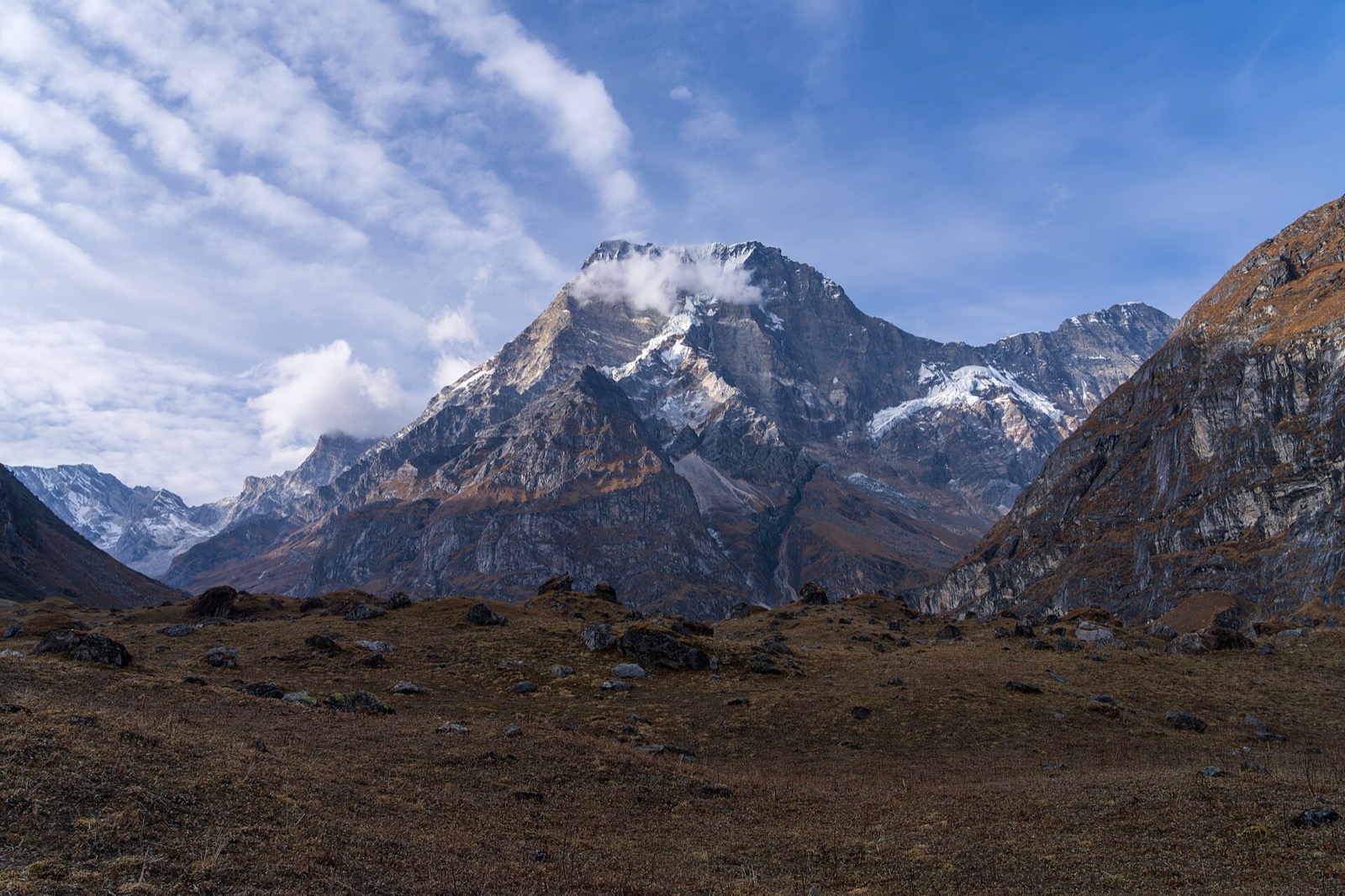
Api Nampa is a conservation area rather than a national park: it is named after the peaks Api and Nampa, and was set up to conserve the biodiversity and cultural heritage of the area4. This page covers the area itself, its entry fee and the permit row that applies in Darchula. The walking route to the foot of Api is on the Api base camp trek page, and fee tables for other protected areas are in the permits hub.
Where it is
The area lies in Darchula district and covers 1,903 sq. km in 21 VDCs5. It ranges in elevation from 518 to 7,132 m at the Himalayan peak Api and is part of the Kailash Sacred Landscape4. A grasslands plateau lies at the centre, mixed with various forest types4. About 54,358 people live in 8,966 households inside the area4.
Byansi and Shauka communities live in the area, with trans-border trade links to Tibet1.
Wildlife
The Nepal Tourism Board lists the snow leopard, musk deer, clouded leopard, ghoral, Himalayan black bear and Himalayan tahr as found in the area5. Other mammals recorded include red panda, common langur and serow4. Birds include Himalayan monal, snowcock and blood pheasant4, and The Record counts 243 bird species8.
Entry fee
Entrance fees must be paid to enter protected areas of Nepal2. In October 2026 the Nepal Tourism Board’s park entry-fee table listed Api Nampa Conservation Area as follows, with children under 10 free2:
| Visitor | Api Nampa entry | Seen |
|---|---|---|
| Nepali | NPR 100 per person per entry | October 20262 |
| SAARC national | NPR 500 per person per entry | October 20262 |
| Foreigner | NPR 2,000 per person per entry | October 20262 |
In October 2026 the same table said entry fees may be paid at the Tourist Service Center in Bhrikutimandap, Kathmandu, or at the entry points2. The Department of National Parks and Wildlife Conservation’s online ticketing system lists ticket types such as Nepali, SAARC or Foreigner, with prices shown per day, per person, per entry6. It also lists an Api-Nampa Conservation Area office among its field offices10. Tables for other areas are in national park fees.
Trekking permit
In October 2026 the Department of Immigration’s trekking permit table listed one Darchula row: USD 90 per person per week, then USD 15 per day beyond 1 week, for Vyas Rural Municipality ward 13. See restricted-area permits for the rest of the table.
Visitor numbers
In June 2019 The Record reported that between September to October 2015 and November to December 2018 only 5 SAARC tourists and 59 non-SAARC tourists visited8. It described information on Api Nampa as scarce, and organising treks in Darchula as considerably harder than in more established areas because the tourism industry there was nascent8. It also reported little to no publicity around the area8.
When to go
Alpine Journeys names pre-monsoon, March to May, as the best season for Api base camp, when rhododendrons are in full bloom, followed by October and November with clear skies9. December to February is very cold with blockades due to snow, and the monsoon months of June to September bring rain that makes trails slippery and difficult9.
Getting there
In June 2019 The Record described the bus ride from Dhangadhi to Khalanga Bazaar, the Darchula district headquarters, as 18 hours8. Western Nepal Treks flies Kathmandu to Dhangadhi in almost 1 hour, runs a night bus from Attariya to Latinath of about 260 km and 13 hours, and starts its Api trek at Makarighad in Darchula7. Alpine Journeys describes the Api route as mostly a camping trek, with porters carrying tents9. For the district see Darchula.
Read next
Api base camp trek: route, days, season and costs from Darchula
Api Himal base camp trek in Darchula: 9, 12 and 16-day operator itineraries, base camp altitude, best months, the Darchula permit row, park entry, prices.
District guidesDarchula: Khalanga, Api Nampa and the Mahakali border
Darchula district guide: Khalanga on the Mahakali, Api Nampa Conservation Area fees, the Darchula permit, Byans villages and when to go.
Permits and feesNational park fees: Rara, Khaptad, Shey-Phoksundo and Api Nampa
Park entry fees for Rara, Khaptad, Shey-Phoksundo and Api Nampa by visitor type, with the date each fee was seen, how to pay and how to book online.
Questions travellers ask
How much is the Api Nampa Conservation Area entry fee?
In October 2026 the Nepal Tourism Board listed NPR 100 for Nepalis, NPR 500 for SAARC nationals and NPR 2,000 for foreigners, each per person per entry, with children under 10 free2. Fees may be paid at the Tourist Service Center in Kathmandu or at the entry points2.
Is a trekking permit needed for Api Nampa?
In October 2026 the Department of Immigration's trekking permit table listed one Darchula row: USD 90 per person per week, then USD 15 per day beyond 1 week, for Vyas Rural Municipality ward 13. Separately, entrance fees must be paid to enter protected areas of Nepal2.
How big is Api Nampa Conservation Area?
It covers 1,903 sq. km in 21 VDCs of Darchula district5. Its elevation ranges from 518 m to 7,132 m at the peak of Api4. It was established in 2010 and is part of the Kailash Sacred Landscape4.
Sources
- Api Nampa Conservation Area - Nepal Climbing Adventures · Nepal Climbing Adventures · nepalclimbing.com · checked 19 October 2026
- Park Entry Fees in Nepal · Nepal Tourism Board · ntb.gov.np · checked 19 October 2026
- Trekking Route and Permit Fee · Department of Immigration, Nepal · immigration.gov.np · checked 19 October 2026
- Api Nampa Conservation Area - Wikipedia · Wikipedia · en.wikipedia.org · checked 19 October 2026
- Api Nampa Conservation Area - Nepal Tourism Board · Nepal Tourism Board · ntb.gov.np · checked 19 October 2026
- DNPWC Online Ticketing User Manual · Department of National Parks and Wildlife Conservation · onlineticketing.dnpwc.gov.np · checked 19 October 2026
- Api Base Camp Trek - Western Nepal Treks · Western Nepal Treks · westernnepaltreks.com · checked 19 October 2026
- Api Nampa Conservation Area has been a colossal failure · The Record · recordnepal.com · checked 19 October 2026
- Api Base Camp Trek - Alpine Journeys Treks & Expedition · Alpine Journeys Treks & Expedition · alpinejourneys.com · checked 19 October 2026
- Api-Nampa Conservation Area Office - DNPWC · Department of National Parks and Wildlife Conservation · dnpwc.gov.np · checked 19 October 2026
Image credits (1)
- Sunuwargr / Wikimedia Commons · CC BY-SA 4.0 · source

Fees, fares and road conditions change: each note shows the date it was checked. How we check facts · Report an error.