Contents
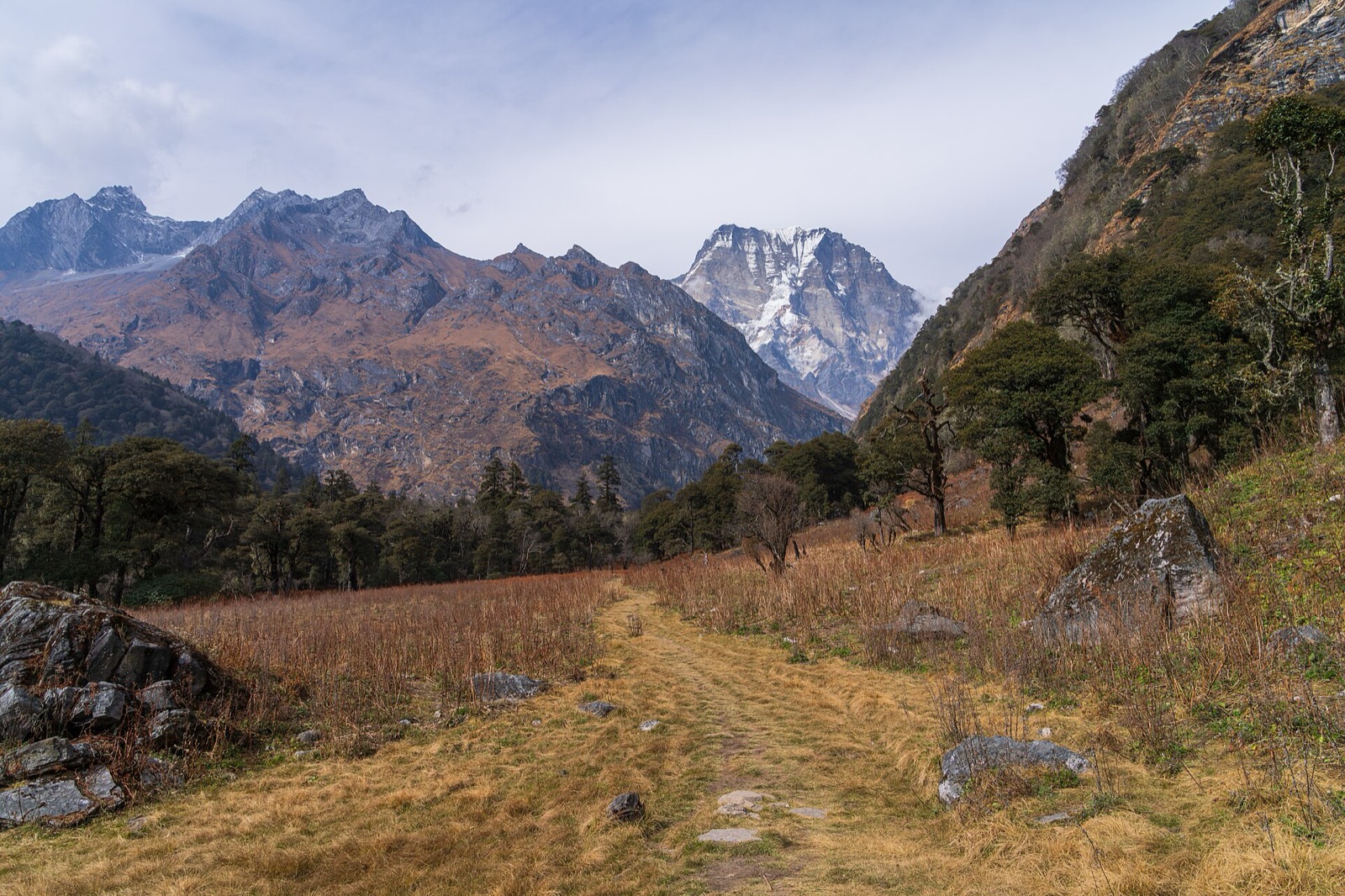
Api Himal stands at 7,132 m in Darchula district, near Nepal’s border4. The base camp trek is the walk to its foot, and operators disagree on how long it takes and how high base camp sits, so this page sets the three published itineraries side by side. Other far-west routes are listed in the treks hub, and the protected area is covered in Api Nampa Conservation Area.
Route and days
Western Nepal Treks’ 12-day version starts and ends at Makarighad1. Its header lists public vehicle transport, local homestay accommodation and a group size of 2 or more1. It reaches the trailhead by bus and jeep and gives distances for each stage1:
| Day | Stage | Distance or time |
|---|---|---|
| 2 | Night bus Attariya to Latinath | about 260 km, 13 hours1 |
| 3 | Jeep Latinath to Makarigad, trek to Khandeshwori | 13 km by jeep, 6 km walking1 |
| 4 | Khandeshwori to Thumti to Lumcha | 12 km, 7.5 hours1 |
| 5 | Lumcha to Chhirchhire to Simar | 10 km, 5 hours1 |
| 6 | Simar to Dhaule Odar, Bhabaiya Valley outing | 9 km one way, plus 6 km return1 |
| 7 | Dhaule Odar to Api base camp and Kali Dhunga lake, back to Dhaule Odar | about 15 km1 |
| 8 | Dhaule Odar to Simar to Chhirchhire to Khaykot | 18 km1 |
| 9 | Khaykot to Sitti Village to Ghusha to Jhusku | 14 km1 |
| 10 | Jhusku to Makarigad, jeep to Latinath | 4 km walking, 7 km by jeep1 |
Best Heritage Treks’ 9-day version reaches base camp on day 42:
| Day | Stage | Altitude | Time |
|---|---|---|---|
| 3 | Makarigaad to Ghusa Village and Siti Village | Ghusa 2,000 m, Siti 2,400 m | 6 to 7 hours, gaining 1,100 m2 |
| 4 | Siti Village to Dhauliodhar and Api base camp | Dhauliodhar 3,200 m, base camp 4,100 m | 8 to 9 hours2 |
| 5 | Exploration day at base camp | not listed | not listed2 |
| 6 | Base camp down to Siti Village | 2,400 m | 7 to 8 hours2 |
| 7 | Ghusa Village to Makarigaad, drive to Gokuleshwor | not listed | 4 hours walking, 3 hours driving2 |
Best Heritage Treks’ 9-day version bookends the walk with road days. Day 1 is a tourist bus from Kathmandu to Attariya, a 14 to 16 hour overland drive2. Day 2 is a 4WD run from Attariya to Gokuleshwor and Makarigaad of 9 to 10 hours2. The way out is day 8, a 6 to 7 hour drive from Gokuleshwor to Attariya, and day 9, a 14 to 16 hour overnight bus to Kathmandu2.
Alpine Journeys’ 16-day version flies to Dhangadhi and drives to Gokuleshwor on day 33. Its walking stages run day by day3:
| Day | Stage |
|---|---|
| 4 | Gokuleshwor to Chiureni3 |
| 5 | Chiureni to Makarighat3 |
| 6 | Makarighat to Seti3 |
| 7 | Seti to Domal3 |
| 8 | Domal to Dhaulo Odar3 |
| 9 | Dhaulo Odar to Api base camp, 3,900 m3 |
| 10 | Api base camp to Saheb Bagar3 |
The same page returns by road to Dhangadhi on day 14 and flies to Kathmandu on day 153.
Itineraries side by side
The three published versions differ most in length, base camp day and grade1,2,3.
| Version | Length | Base camp reached | Grade |
|---|---|---|---|
| Best Heritage Treks | 9 days from Kathmandu2 | Day 4, at 4,100 m2 | Demanding or strenuous, rapid altitude gain2 |
| Western Nepal Treks | 12 days, ending with a jeep to Latinath on day 101 | Day 7, with a return to Dhaule Odar the same day1 | Not graded1 |
| Alpine Journeys | 16 days from Kathmandu3 | Day 9, at 3,900 m3 | Moderate3 |
The short version gets to base camp fastest by driving the whole road to Makarigaad first and gaining 1,100 m on day 32. The long version spends 6 more days walking in and out through Chiureni, Makarighat, Seti and Domal3. Alpine Journeys’ return leaves Dhangadhi on day 15 by air to Kathmandu, after a drive back on day 143.
Highest point
Best Heritage Treks gives 4,100 m for Api base camp2, and Alpine Journeys gives 3,900 m3. Western Nepal Treks lists a maximum altitude of 4,200 m in its header1. This page uses 4,100 m, which Best Heritage Treks gives in both its header and its day 4 stage2. The peak itself is 7,132 m4, and the Api Nampa Conservation Area climbs from 518 m to that summit6.
The mountain
Api, also called Api Himal, is the highest peak in the Yoka Pahar section of the Gurans Himal4. It is the highest mountain in Nepal’s far west, in Darchula district of Sudurpashchim Province near the international border2,4. Its south face rises 3,300 m above its base4, and the first ascent was in 19604.
The base camp days are long: Western Nepal Treks’ day 7 covers about 15 km to base camp and the Kali Dhunga lake and back to Dhaule Odar1. Best Heritage Treks puts the climb from Siti Village to base camp at 8 to 9 hours of strenuous trekking2.
How hard is it
Best Heritage Treks grades its 9-day trek demanding or strenuous, with rapid altitude gain2. Day 3 gains 1,100 m in 6 to 7 hours of trekking, and day 4 takes 8 to 9 hours to reach 4,100 m2. Alpine Journeys grades the 16-day version moderate and asks for 5 to 7 hours of walking a day with a light backpack3.
The 12-day version has stages of 5 hours to 7.5 hours on the way in, and a day of 18 km on the way out1. Alpine Journeys runs the trek mostly as a camping trek, with porters carrying the tents and camping equipment3.
Season
Alpine Journeys names pre-monsoon, March to May, as the best season, when rhododendrons are in full bloom, followed by October and November with clear skies3. Its header lists March to May and September to November3. December to February is very cold, with snow blocking routes, and the monsoon months of June to September bring rain that makes trails slippery and difficult3.
Best Heritage Treks pitches its 9-day version to Nepali tourists for Ashoj and Kartik, the months of Dashain and Tihar2.
Permits
In October 2026 the Department of Immigration’s trekking permit table carried one Darchula row: USD 90 per person per week, then USD 15 per day beyond 1 week, for Vyas Rural Municipality ward 15. The row does not name Api or Makarighad.
The Api Nampa Conservation Area, which reaches up to Api peak at 7,132 m6, charges entry per person per entry. In October 2026 the Nepal Tourism Board’s park entry-fee table set it as follows, with children under 10 free7:
| Visitor | Api Nampa entry | Seen |
|---|---|---|
| Nepali | NPR 100 per person per entry | October 20267 |
| SAARC national | NPR 500 per person per entry | October 20267 |
| Foreigner | NPR 2,000 per person per entry | October 20267 |
Area-by-area rules are in restricted-area permits.
Costs
In October 2026 Western Nepal Treks priced a trekking package at 1,550 euro, with a 400 euro flight ticket extra as an option1. The same page put the one-way Kathmandu to Dhangadhi flight at almost USD 2001.
Alpine Journeys’ version is mostly a camping trek with porters carrying tents, with basic teahouses or homestays in a few lower villages3. Its package includes the 2-way flight between Kathmandu and Dhangadhi and takes groups of 1 to 20 people3. Best Heritage Treks’ 9-day itinerary page is dated 19 June 20262. That plan gives day 5 as an exploration day at base camp, and day 6 as a 7 to 8 hour downhill walk to Siti Village2.
The conservation area
The Api Nampa Conservation Area was established in 2010 and covers 1,903 sq. km8. It takes in parts or all of five rural municipalities and one municipality, with a resident population of approximately 60,000 people8. It borders India to the west8, and it is part of the Kailash Sacred Landscape6. The ICIMOD biodiversity profile is the nonprofit source for those figures.
Getting to the trailhead
The base is Dhangadhi. From Kathmandu, the flight takes about 1 hour1, and the overland alternative is a night bus to Attariya of about 750 km and 18 hours1. Best Heritage Treks gives 14 to 16 hours for the Kathmandu to Attariya bus2.
From Attariya the road goes up to Latinath, a night bus of about 260 km and 13 hours1, and then a jeep on to Makarigad1. Best Heritage Treks drives Attariya to Gokuleshwor and Makarigaad in 9 to 10 hours in a 4WD vehicle2. The route and its places are covered in Darchula.
Read next
Api Nampa Conservation Area: entry fee, permits and how to reach it
Api Nampa Conservation Area in Darchula: entry fee for Nepalis, SAARC nationals and foreigners, the Darchula permit row, access from Dhangadhi, best months.
TreksSaipal base camp trek: routes from Simikot and Chainpur, days and costs
Saipal Himal base camp trek: the Simikot (Humla) and Chainpur (Bajhang) approaches, stages, base camp altitude, best months, permit rows and prices.
District guidesDarchula: Khalanga, Api Nampa and the Mahakali border
Darchula district guide: Khalanga on the Mahakali, Api Nampa Conservation Area fees, the Darchula permit, Byans villages and when to go.
Questions travellers ask
How many days does it take to trek to Api Base Camp?
Operators give 9 days2, 12 days1 and 16 days3 from Kathmandu. The 9-day version uses night buses and 4WD transfers2; the 16-day one adds a trek-preparation day and flies to Dhangadhi on day 33.
How hard is the Api Himal trek?
Best Heritage Treks grades the 9-day version demanding or strenuous because of rapid altitude gain2. Alpine Journeys grades its 16-day version moderate and asks for 5 to 7 hours of walking a day3.
When is the best time for Api base camp?
March to May is the best season, with rhododendrons in bloom, followed by October and November with clear skies3. Winter from December to February is very cold, with snow blocking routes, and June to September rain makes trails slippery3.
How much does the Api Himal trek cost?
In October 2026 Western Nepal Treks priced its trekking package at 1,550 euro, with a flight ticket extra at 400 euro as an option1. The same page put a one-way Kathmandu to Dhangadhi flight at almost USD 2001.
Sources
- Api Base Camp Trek - Western Nepal Treks · Western Nepal Treks · westernnepaltreks.com · checked 19 October 2026
- Best 9-Day Api Himal Base Camp Short Trek Itinerary · Best Heritage Treks · bestheritagetour.com · checked 19 October 2026
- Api Base Camp Trek - Alpine Journeys Treks & Expedition · Alpine Journeys Treks & Expedition · alpinejourneys.com · checked 19 October 2026
- Api (mountain) - Wikipedia · Wikipedia · en.wikipedia.org · checked 19 October 2026
- Trekking Route and Permit Fee · Department of Immigration, Nepal · immigration.gov.np · checked 19 October 2026
- Api Nampa Conservation Area - Wikipedia · Wikipedia · en.wikipedia.org · checked 19 October 2026
- Park Entry Fees in Nepal · Nepal Tourism Board · ntb.gov.np · checked 19 October 2026
- Biodiversity Profile of the Api Nampa Conservation Area · ICIMOD · lib.icimod.org · checked 20 October 2026
Photos (1)
- Sunuwargr, CC BY-SA 4.0

Fees, fares and road conditions change: each note shows the date it was checked. How we check facts · Report an error.