Contents
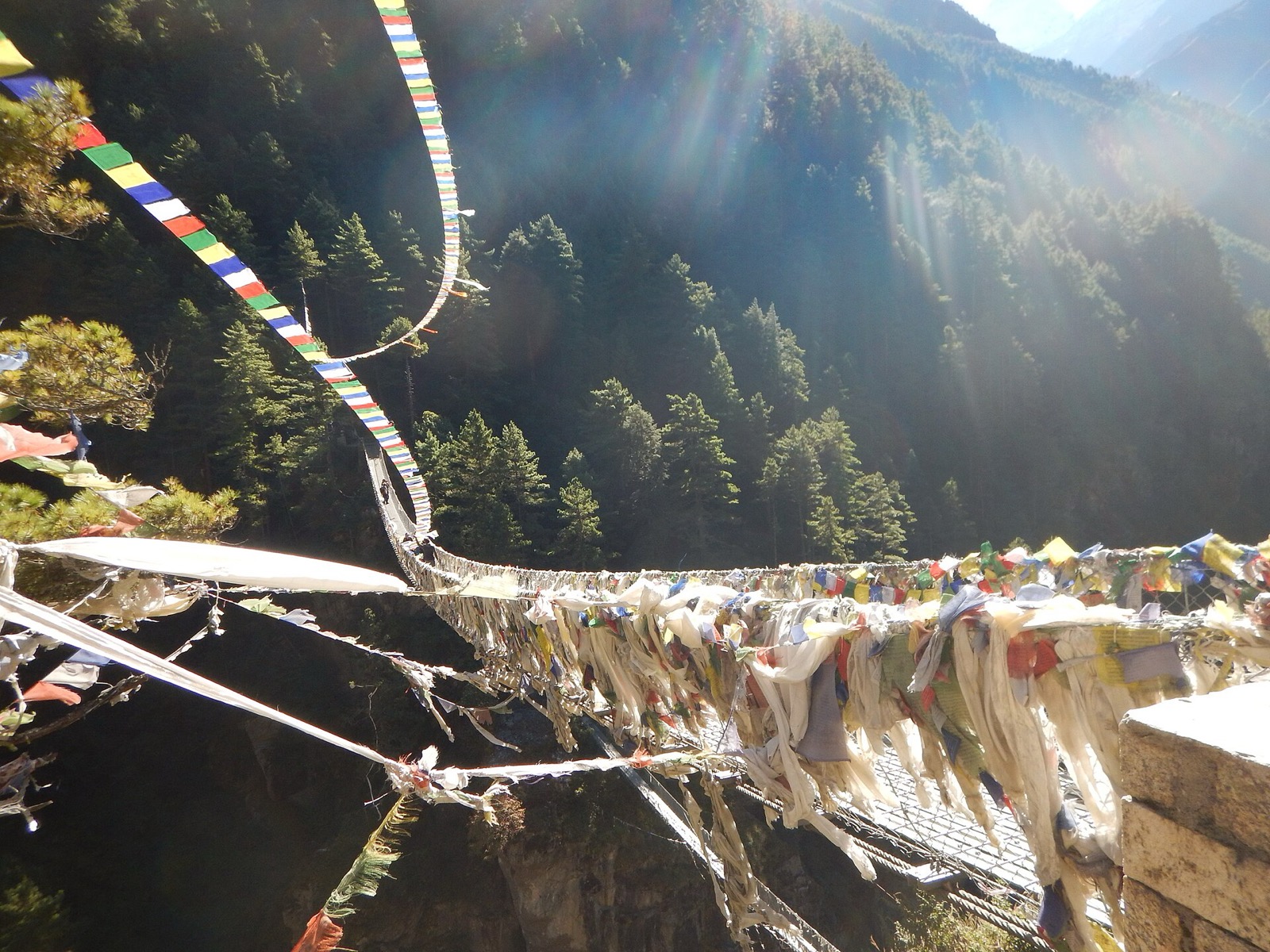
Trail bridges are the footbridges that carry hill paths over rivers. The wider set of rural access pages is in the rural roads hub; how the roads themselves are built is in how rural roads are built.
How many trail bridges there are
The Department of Local Infrastructure Development and Agricultural Roads (DoLIDAR) project page for the Trail Bridge Sector Wide Approach counted 8,444 trail bridges in the country on the page seen in October 2026, with a further 4,000 to 5,000 needed1. Its record gives the period of TB SWAp-III as 2019 to 20221. Construction under the programme has been ongoing since 2009, with Swiss government support1.
| Source | Figure | Note |
|---|---|---|
| DoLIDAR project page (government) | 8,444 trail bridges | Plus 4,000 to 5,000 still needed1 |
| Helvetas | Over 10,000 built | About two thirds through successive Swiss-funded projects2 |
| Open Transportation Journal, December 2024 | Over 10,000 built | Celebrated as the 10,000th bridge in November 20233 |
| Kathmandu Post article, July 2026 | More than 11,000 | By 2023, when Helvetas ended direct support7 |
The government record is the lowest figure, and the sources give no reason for the gap. The government page is the only one that also gives the shortfall.
Around 700 trail bridges and around 400 motorable bridges are built across the country each year, according to the 2024 journal paper3. Over 1,000 trail bridges were reported under construction annually, monitored through four monitoring information systems6. The DoLIDAR record gives an average of 450 bridges built a year under the sector wide approach1.
Targets set along the way
The first Trail Bridge Strategy, in 2006, set a national target that no citizen should walk a detour of more than one hour without a safe river crossing6. A survey then showed Nepal needed 6,000 additional trail bridges6. By 2019 over 8,000 had been completed, and a review said 2,400 more were needed to meet the target6. The same one-hour detour remains the stated goal of the TB SWAp1.
How the programme grew
The first trail bridges came in the Rana period, when 29 steel bridges made in Scotland were erected between 1846 and 19506. Systematic trail bridge construction began in 1960 with support from the Swiss Development Cooperation3. Only 10 bridges were built in the 1970s and 25 in the 1980s6.
| Year | Step | Source |
|---|---|---|
| 1960 | Systematic construction begins with Swiss support | 3 |
| 1985 | Swiss support helps publish district Main Trail maps | 6 |
| 1990 | Bridge Building at Local Level programme launched | 3 |
| 1995 | Wooden walkway decks replaced by galvanised steel plates | 6 |
| 2006 | First Trail Bridge Strategy sets the one-hour target | 6 |
| 2008 | South-South Cooperation Unit set up, now TRAC4Change | 7 |
| 2009 | Trail Bridge Sector Wide Approach starts | 1 |
| 2011 | Local Road Bridge Program begins local-government bridge building | 3 |
| November 2023 | Swiss technical assistance ends | 6 |
The wooden planks needed frequent replacement, and the steel plate decks reduced maintenance cost6. Three phases of the sector wide approach, from 2009 to 2023, built nearly 4,000 new bridges6. Early priority went to remote mountain settlements; later demand includes designs for lowland areas2.
How trail bridges are built
Unlike conventional bridges, trail bridges could be built without heavy machinery, with materials carried by hand and much of the work done by local communities4. Ansu Tumbahangfe, director of TRAC4Change, estimates that a trail bridge costs at least ten times less than a conventionally designed bridge4.
Short-span bridges, those under 120 m long, are covered by a national guideline and make up 90% of trail bridges2. Sixteen manuals guide practitioners on technical norms, standards, designs and implementation, incorporating gender equality and social inclusion5. The manuals cover surveying, design, construction, maintenance and quality control7. Quality monitoring has been formalised in a monitoring manual since 20096.
| Item | Figure | Source |
|---|---|---|
| Typical 60-metre bridge cost, July 2026 | $80,000 to $100,000 | 7 |
| Time to design and build, early years | Three years | 6 |
| Time to design and build, today | 18 months | 6 |
| Fabricators making parts | 33, across all seven provinces | 6 |
| Parts made for | 900 bridges a year | 6 |
The Yarubagar Cantilever Trail Bridge in Gorkha spans 195 metres and cost NRs 38 million in 20163. It is the first cantilever bridge in Nepal3. About 30 engineering students graduate each year with trail bridge know-how6.
Who runs them
In Alliance2015’s account, the lead role for the trail bridge programme has always been with the government, with the Swiss Agency for Development and Cooperation and Helvetas giving financial and technical support5. The Swiss agency commissioned Helvetas to continue technical assistance from December 2019 to November 20232. Nepalese engineers are now fully in charge and are developing new designs for new needs2.
Each short-span bridge gets a user group committee, which must include women and members of disadvantaged groups2. Fifty percent of user committee representatives should be women, and at least 35% of the people involved in bridge construction are now women5.
On completion a public meeting is held to verify that the bridge meets quality standards and that funds were used properly2. A public audit also covers technical, social and financial issues5. A Bridge Warden is then appointed to oversee operation and upkeep2.
After federalism
Nepal became a federal country after its 2015 constitution, with 7 provinces and 753 local units3. Local governments were then given responsibility for supervising new bridge construction, and it saw a boom6. Provincial governments built 396 trail bridges between fiscal years 2018/19 and 2022/233. The TB SWAp covers the federal government, 7 provinces and 753 urban and rural municipalities1. Swiss technical assistance ended in November 2023, and local municipalities and provinces took over6.
Floods and earthquakes
Several bridges were damaged by floods and landslides in 1993, again in September 2024, and by the 2015 earthquake, disconnecting various districts and the capital, Kathmandu3. The 2024 journal paper counted 44 motorable bridges and 11 trail bridges damaged in the 2024 floods3. The 2015 earthquake damaged 79 of the 6,000 trail bridges built until then6. A study of the damaged bridges led to designs refined to increase seismic resistance6.
What they changed
Each bridge makes the routes used by an average 1,800 people shorter and safer, according to Helvetas2. The Kathmandu Post cites studies reporting a 16 percent rise in school attendance and 31 percent in antenatal healthcare access4. Helvetas reports a 26% rise in health centre consultations after a new bridge2.
| Measure | Result | Source |
|---|---|---|
| People per bridge per day, TB SWAp-I | 153 on average | 1 |
| Schools, attendance, TB SWAp-I | Up 5% to 20% | 1 |
| Patients from across rivers reaching health facilities, TB SWAp-I | Up 40% | 1 |
| Patients seeking health facilities, outcome studies | Up 23% | 1 |
| Bridge sites with new markets, outcome studies | 20% | 1 |
| Time saved on a two-way journey, TB SWAp-II | 2.3 hours | 1 |
Use figures are reported on different measures, and the 153 daily users per bridge, Helvetas’s 1,800 and the totals below are not the same count. DoLIDAR gives over 1.3 million people crossing trail bridges daily to reach schools, health facilities and markets1. The 2024 journal paper estimates about 1.8 million people a day3, and the Kathmandu Post gave over one million crossings each day in July 20267. The broader record of what access changed is in what roads changed, and hazards on the same hill routes are in landslides and road safety.
Know-how abroad
Helvetas established the South-South Cooperation Unit, now TRAC4Change, in 20087. Nepali engineers have since helped governments in 11 countries, including Bhutan, Ethiopia, Tanzania, Indonesia, Guatemala and Afghanistan, develop their own trail bridge programmes7. In Ethiopia 272 trail bridges have been built with Nepali support7.
Read next
How rural roads are built in Nepal's hills
How hill roads in Nepal are planned and built: the rural road standards, labour-based Green Roads, dry stone walls, phased widening and who decides.
Rural roadsWhat roads changed in remote Nepal: markets, work and landslides
What rural roads changed in Karnali and Nepal's hills: markets and work after the Karnali Highway, the evidence from 200 wards, and the landslide cost.
Rural roadsLandslides and road safety on Nepal's hill roads
Why unplanned hill roads trigger landslides in Nepal, what a 2018 study found within 100 m of roads, and the night-time travel bans of September 2026.
Questions travellers ask
How many trail bridges are there in Nepal?
The DoLIDAR project record for the Trail Bridge Sector Wide Approach counts 8,4441. Helvetas counts over 10,000 built2, and a Kathmandu Post article of July 2026 puts the total at more than 11,000 by 20237.
How are trail bridges built in Nepal?
Trail bridges could be built without heavy machinery, with materials carried by hand and much of the work done by local communities4. Short-span bridges under 120 m fall under a national guideline and are 90% of the total2.
How much does a trail bridge cost?
A typical 60-metre trail bridge costs between $80,000 and $100,000, in a Kathmandu Post article of July 20267. TRAC4Change's director estimates a trail bridge at least ten times cheaper than a conventionally designed bridge4.
How long does it take to build a trail bridge?
Each bridge took three years to design and build in the early years, against 18 months today6. The 195-metre Yarubagar cantilever bridge in Gorkha cost NRs 38 million in 20163.
Who looks after a trail bridge?
After completion, a Bridge Warden is appointed to oversee the operation and upkeep of the bridge2. Each short-span bridge also has a user group committee that must include women and disadvantaged groups2.
What difference do trail bridges make?
A Kathmandu Post article cites studies reporting a 16 percent rise in school attendance and 31 percent in antenatal healthcare access after bridges4. The government record reports 1.3 million people crossing trail bridges daily to reach schools, health facilities and markets1.
Sources
- Trail Bridge Sector Wide Approach, TB SWAp - Framework-III · Department of Local Infrastructure Development and Agricultural Roads (DoLIDAR), Government of Nepal · doli.gov.np · checked 19 October 2026
- Suspension Bridges for Safe Routes and Democracy (Helvetas, Nepal) · Helvetas · helvetas.org · checked 19 October 2026
- Bridges in Nepal: Enhancing Connectivity and Economic Development · The Open Transportation Journal (2024) · opentransportationjournal.com · checked 19 October 2026
- How Nepal became the developing world's bridge builder · Asia News Network (Kathmandu Post article) · asianews.network · checked 19 October 2026
- 10'000 trail bridges in Nepal: a model for locally-led development · Alliance2015 · alliance2015.org · checked 19 October 2026
- 10,000 bridges · Nepali Times · nepalitimes.com · checked 20 October 2026
- How Nepal became the developing world's bridge builder · Kathmandu Post · kathmandupost.com · checked 20 October 2026
Photos (1)
- Dario Severi, CC BY-SA 4.0

Fees, fares and road conditions change: each note shows the date it was checked. How we check facts · Report an error.